
A bilingual resume highlights your skills in foreign languages as much as it showcases other job-related qualifications. When a role requires bilingual candidates, properly emphasizing that you’re bilingual can mean the difference between immediately receiving an interview invite or having your resume discarded on the spot.
In this article, we’ll thoroughly explain a bilingual resume. We’ll show you where and how to add language skills to ensure the document looks professional and communicates your qualifications optimally. We’ll also show you complete examples of bilingual resumes and even discuss how to show that you’re bilingual in a cover letter.
Key Takeaways
A bilingual resume focuses on emphasizing your proficiency in one or more foreign languages in addition to other qualifications.
You can add language skills to your resume summary or objective, work experience, and skills sections.
Use the established framework of reference to standardize your skill levels.
You can provide more context about your language skills in your cover letter.
Excellent Bilingual Resume Examples
Before we proceed to the resume writing process, let’s see two complete resume examples to give you an idea of what these documents look like. You can use them as templates for your bilingual resume.
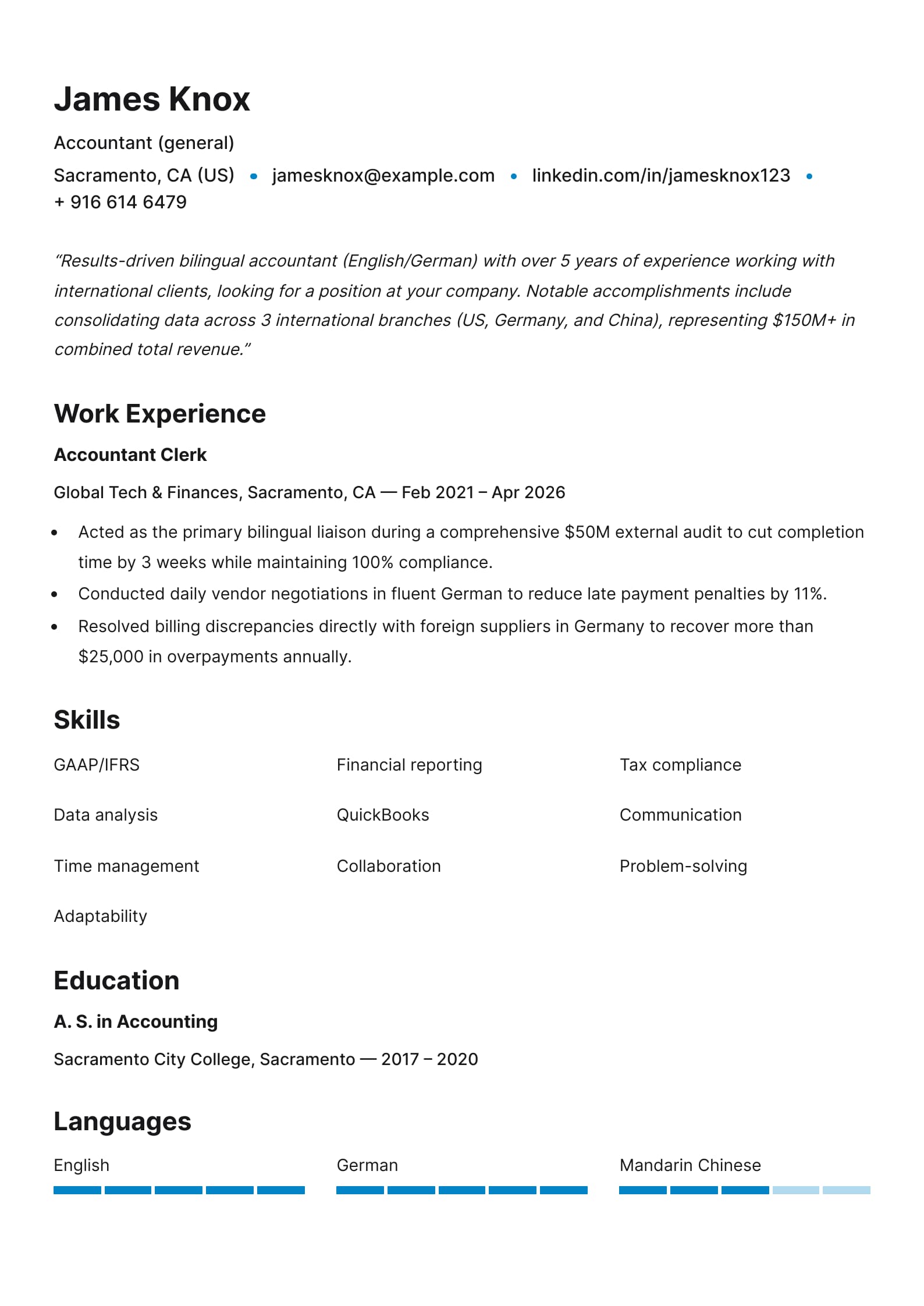
Bilingual Accountant Resume Example
Let’s start with a bilingual resume example for an accountant:
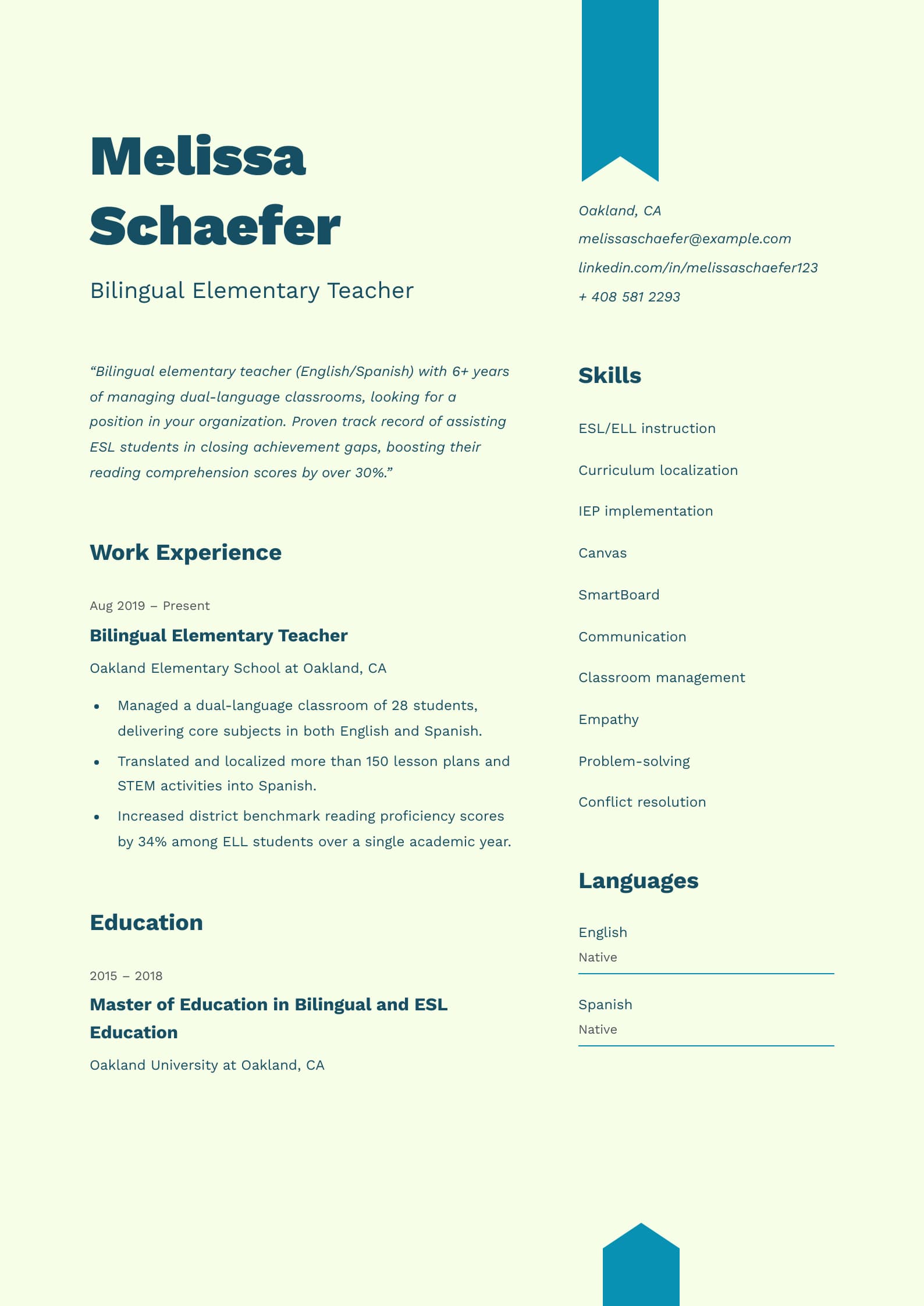
Bilingual Teacher Resume Example
Now, here’s a bilingual resume example for a teacher:
What Is a Bilingual Resume?
A bilingual resume is meant to emphasize advanced knowledge in two or more languages in addition to other relevant qualifications. Nine out of 10 employers rely on U.S. employees who know languages other than English, making a bilingual resume a powerful tool in today’s job market.
It’s important to note that a bilingual resume isn’t written in two different languages, though this is a common misconception. However, it’s also not a standard resume that simply mentions a foreign language once in the skills section.
Instead, a bilingual resume is structured around your linguistic abilities. It’s typically designed for the roles where fluency in a second language is either a strict requirement or offers a significant advantage over the competition.
This is common in fields like education, healthcare, customer service, and international business, or when writing an interpreter or translator resume.
Bilingual resumes strategically point out efforts and accomplishments related to language skills throughout the document. This approach instantly signals hiring managers that you have proven linguistic capabilities. Plus, it scores highly with applicant tracking systems (ATS) that are set up to look for bilingual candidates.
Where to Add Bilingual Skills to Your Resume

You can add bilingual skills to your resume in several key sections. Proper positioning is critical, as burying them too far down the resume may result in recruiters missing them entirely. On the other hand, including them in unrelated sections may disrupt the flow of the entire document.
Let’s look at the key places in your resume where adding bilingual skills will have the biggest effect:
Resume Summary/Objective
Your resume summary or objective is the first section where you should mention fluency in foreign languages. This section sits at the top of the document and acts as its elevator pitch. Its purpose is to emphasize your key strengths to persuade recruiters to pay closer attention to your resume.
If a job posting explicitly demands a second language, you absolutely need to mention that skill in your opening paragraph. You can highlight your fluency directly with your opening hook or incorporate it as a part of your professional title (e.g., “Spanish translator”).
Doing so ensures hiring managers instantly realize that you have this core competency and maximizes your chances of passing ATS screening.
Here’s an example of a good opening sentence for your bilingual resume summary:
Resume Summary Opening Sentence
“Results-driven bilingual accountant (English/German) with over 5 years of experience working with international clients, looking for a position at your company.”
For contrast, here’s a bad example that appears vague and informal:
Bad Example
“Experienced accountant who speaks some Spanish, looking for work.”
Work Experience Section
Your bilingual resume’s work experience section is where you get to prove your language skills. This is where you can show how you used your linguistic prowess to generate concrete business results.
To achieve this, you want to point out specific results or projects where your bilingualism was essential for success. Make sure to include numbers to quantify your efforts and give them measurable value. Additionally, using action verbs and power words can connect everything and make your writing more impactful.
Let’s see a good example of this practice on a bilingual accountant resume:
Bilingual Accountant Work Experience Example
Resolved billing discrepancies directly with foreign suppliers in Germany to recover more than $25,000 in overpayments annually.
However, if you aren’t specific with your accomplishments, you’ll end up with a weak bullet point, like in this poor example:
Bad Example
Worked with suppliers in Germany to reconcile invoices.
Skills Section
Your bilingual resume skills section is where you must list your abilities clearly and professionally, even if you’ve already mentioned them throughout the document.
Recruiters look at these lists to get a quick preview of your skill set. You want them to see your linguistic capabilities, even if they glossed over your summary or work experience.
The key is to separate your language skills from your hard and soft skills. Instead of mixing them up, you should create a distinct sub-category titled “Languages” or “Language Skills.”
You should also use an established framework of reference for languages and always start your list with your strongest language.
Here’s a good example of a bilingual resume skills section:
Skills Section Example
Language Skills
English - Native (ILR Level 5)
German - Bilingual Proficiency (ILR Level 5)
Mandarin Chinese - Professional Working Proficiency (ILR Level 3)
Now, here’s a bad example that mixes languages with other skills:
Bad Example
Skills
Microsoft Word
Fast typing
Time management
German
Japanese
How to List Bilingual Skills Effectively

Effectively listing bilingual skills requires honesty, precision, and standardization.
First, you shouldn’t overestimate your proficiency in foreign languages. Hiring managers can quickly verify your claims during an interview. If you claim to be fluent but struggle during a bilingual interview, you will likely ruin any chance of getting the job.
Next, you need to be precise when qualifying your language skills. Vague or subjective terms, like “good at French” or “communicated in Spanish,” aren’t helping recruiters assess your knowledge. Instead, you want to mention quantifiable achievements and measurable results attained because of your linguistic prowess.
Lastly, when directly talking about your language skills, you need to use one of the official and standardized proficiency frameworks. Depending on your industry and location, you may use one of the following scales:
ILR (Interagency Language Roundtable). This is the main framework used by the U.S. government. Grading goes from 0 (No Proficiency) to 5 (Native/Bilingual Proficiency).
ACTFL (American Council on the Teaching of Foreign Languages). This is a highly granular framework with many assessment levels ranging from Novice to Distinguished. It’s used in both academic and corporate settings.
CEFR (Common European Framework of Reference for Languages). CEFR is a global standard in many regions, including Europe, Latin America, and Asia. Its grading ranges from A1 (Beginner) to C2 (Proficient).
Apart from these standardized metrics, you should also list any linguistic certifications that you hold or courses that you completed. Certifications like DELE for Spanish, DELF for French, and JLPT for Japanese represent concrete proof of your knowledge. You can add them next to the language in the skills section and in the standalone “Certifications” section.
How to Show You’re Bilingual in Your Cover Letter
To show you’re bilingual in your cover letter, you can build a narrative around it and expand on some of the points from your resume.
A cover letter gives you enough room to provide a brief story about how your language skills contribute to positive outcomes and business successes. Your talking points can revolve around bridging cultural gaps, negotiating contracts with overseas vendors, improving relations with international clients, or localizing marketing campaigns.
Keep in mind that, while a cover letter gives you more freedom to express yourself compared to your bilingual resume, it still needs to be concise, relevant, and professional.
If writing isn’t your strongest suit or you aren’t sure how to best emphasize your linguistic prowess, you should check out our cover letter builder. It can help you write this document from scratch in minutes.
Effortlessly Create a Bilingual Resume with Resume.co
Creating a professional, eye-catching, and ATS-compliant resume from scratch is difficult on its own. Making it bilingual adds another layer of complexity. That’s why we suggest you use our resume builder.
Our software offers a range of professional resume templates, a user-friendly interface, an AI writing assistant, a built-in ATS checker, and extensive customization features.
Ready to make your bilingual resume?
Create my resumeClosing Thoughts
On average, bilingual employees have a wage premium of 11% compared to monolingual peers. As a result, adequately demonstrating competence on your bilingual resume won’t just increase your chances of getting the job; it may even help you negotiate a better salary.
Remember to be honest and precise and to use a standardized framework of reference. Don’t just mention your linguistic abilities, but demonstrate them with your accomplishments, and you’ll show concrete proof of your knowledge.
Bilingual Resume FAQs
#1. How do I say I'm bilingual in a resume?
To say that you’re bilingual in a resume, start by emphasizing it in your summary or objective. You should also mention language-related achievements in your work experience section, and list the languages you know using standardized proficiency frameworks in the “Skills” or “Languages” sections.
#2. Should I add being bilingual to my resume?
Yes, in general, you should always add being bilingual to your resume. Even if a role doesn’t explicitly require fluency in another language, adding this skill to your resume can improve your chances with recruiters and even net you a higher salary.
#3. Do I need to create my resume in two languages?
You don’t need to create your resume in two languages for most bilingual roles. As a general rule, you should create your bilingual resume in your primary language. However, if you’re applying for certain international roles, it may be beneficial or required to submit a translated version of your resume.