
A product designer resume is a brief professional document designed to highlight your ability at a glance to solve complex user problems and drive business growth. Its purpose is to grab the attention of a hiring manager and make you stand out among countless other talented professionals.
In this step-by-step guide, we’ll show you how to write a product designer resume that impresses recruiters and lands interview callbacks. We’ll tell you what format to use, show you which sections to include and how to craft them, discuss whether you need a cover letter, and provide you with complete resume examples to illustrate our points.
Key Takeaways
In most cases, your product designer resume should use the chronological format, with functional and combination formats being usable in specific circumstances.
Make sure to have five key sections: contact information, summary or objective, work experience, education, and skills.
You can add a link to your portfolio in the contact information, or you can include a dedicated project section.
The skills you add to your resume should match the requirements from the job ad.
Write a matching cover letter to show willingness to go the extra mile and expand on your resume.
Exceptional Product Designer Resume Examples
Before we proceed with the resume writing guide, let’s examine two complete resume examples for product designers by experience level.
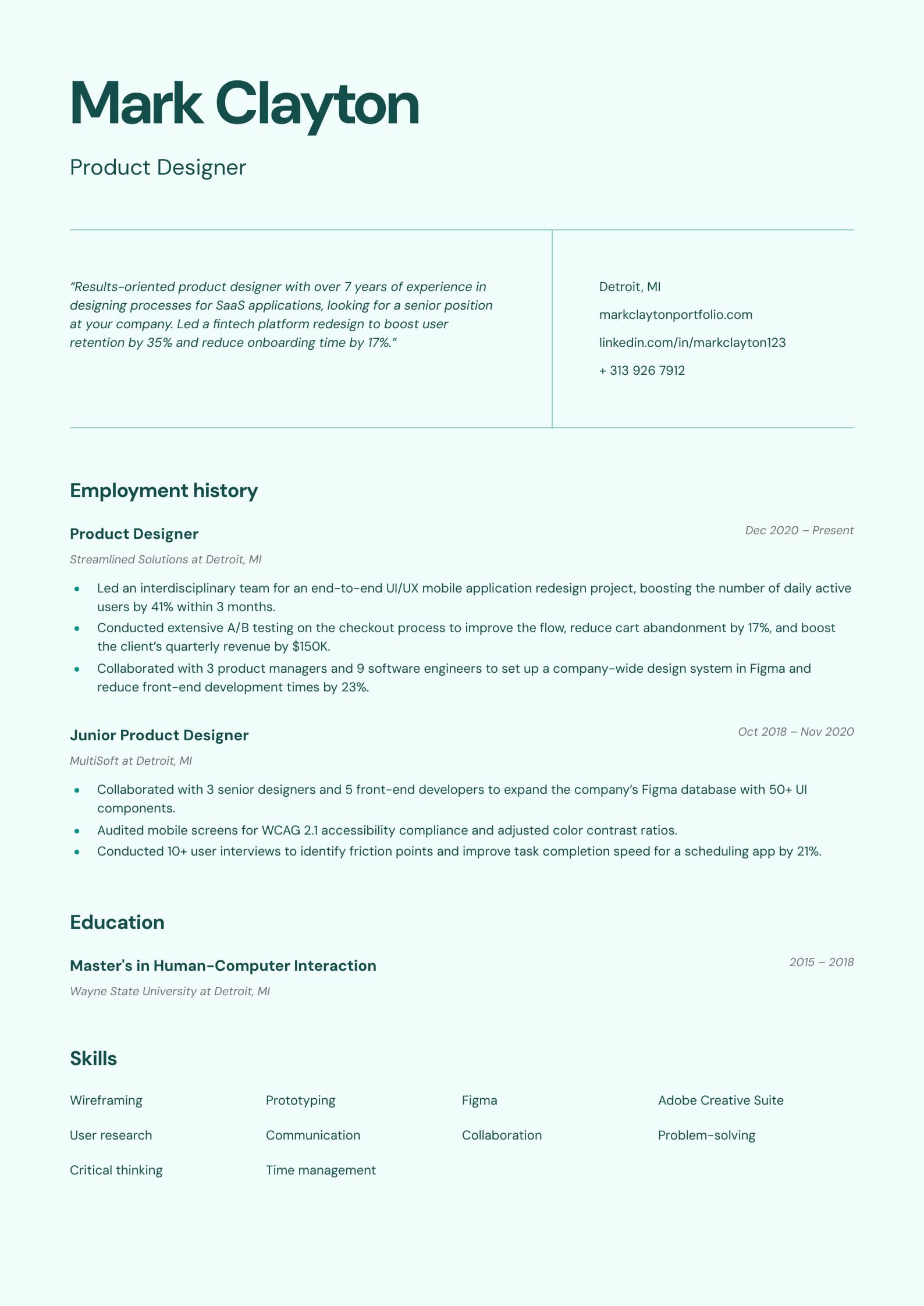
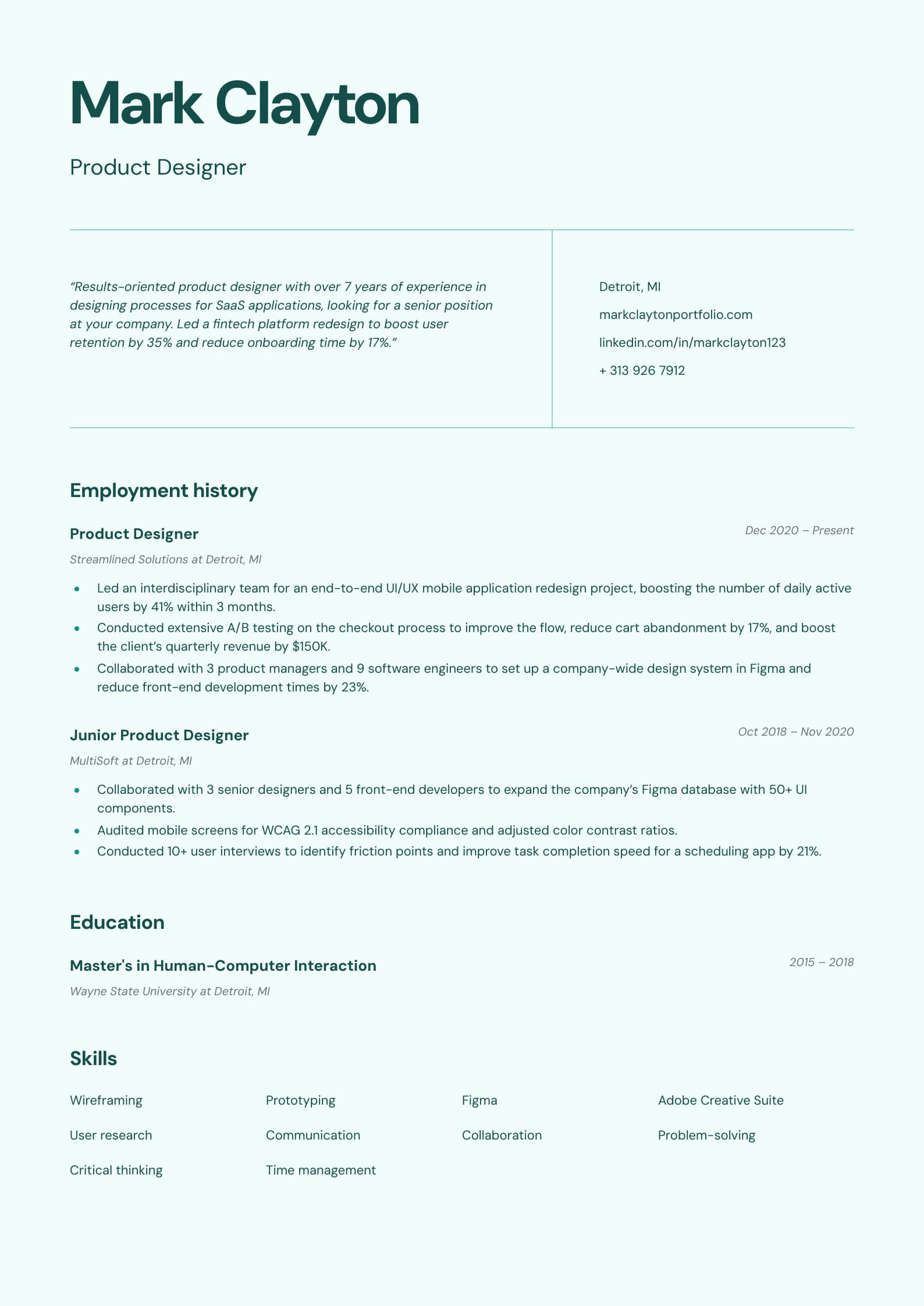
Senior Product Designer Resume Example
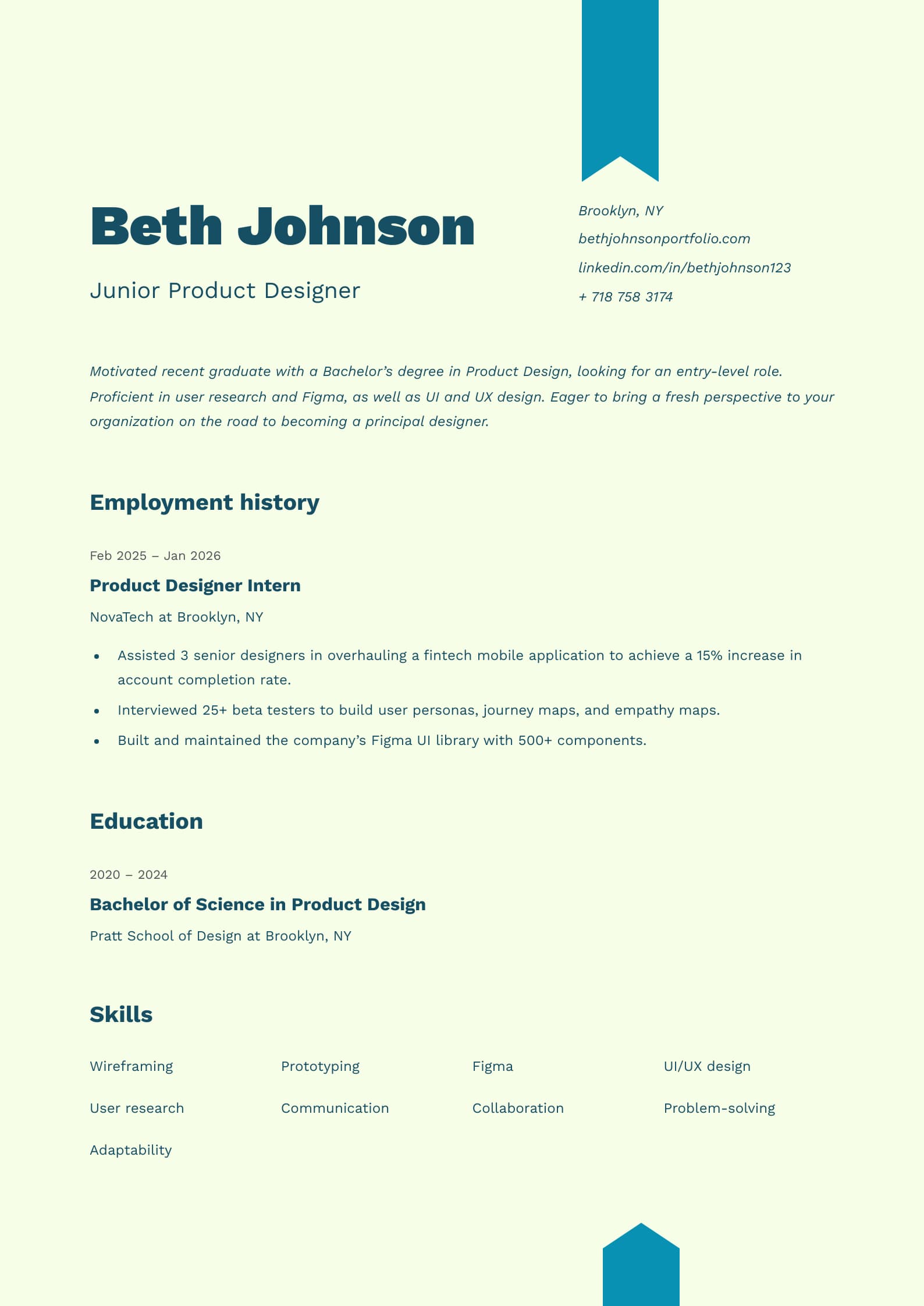
Entry-Level Product Designer Resume
What’s the Best Format for a Product Designer Resume?
The best format for a product designer resume is, in most cases, the chronological resume format. This is the most common resume format and the industry standard. It lists your previous jobs in reverse-chronological order, putting your latest (and often most relevant employment) first and displaying the rest of your work history backward from there.
The chronological format is intuitive and easily scannable. It gives the reader a clear insight into your career development and current skill level, making it a recruiter’s favorite. It’s also compatible with applicant tracking systems (ATS), allowing you to pass software screening with ease. This is not an insignificant thing to consider, given that about 90% of Fortune 500 companies use ATS.
Beyond the chronological format, there are two other formats. The first one—functional resume format—focuses on skills, which makes it suitable for product designers with no experience. The second, i.e. combination resume format highlights skills while combining them with work-related accomplishments.
That said, here’s a brief comparison of the three primary resume formats:
Format | Main Focus | Best Suited For | ATS Compatibility |
Chronological | Work history and career progression | The majority of product designers | Excellent |
Functional | Skills | Beginners | Poor |
Combination | Skills combined with relevant accomplishments | Freelancers and career changes | Moderate |
5 Key Sections of a Product Designer Resume
There are five key sections that each product designer resume needs to have, including:
Key Resume Sections
Contact information
Resume objective/summary
Work experience
Education
Skills
To demonstrate your expertise through concrete examples, you should also include a projects section or a link to your portfolio.
There are several other optional sections that can strengthen your application, based on your qualifications and role requirements. Some examples include:
Optional Resume Sections
Certifications
Awards or publications
Language skills
Hobbies and interests
Formatting all these sections perfectly while ensuring that each one fits properly on a page can be challenging, which is why we recommend you use our creative resume templates.
You can adjust the entire layout with a click of a button and download a finished product in minutes. Moreover, our AI assistant will guide you through the writing process, polishing your message and giving you tailored suggestions.
Product Designer Resume Template
Here’s an example of a product designer resume template that you can use if you go with our resume builder:
Product Designer Resume Template
Name and Surname
Phone number: 000-000-0000 | Email: namesurname@gmail.com | Location: City, State
[Adjective] [your job title] with [years of experience, if applicable] in [your area of expertise, if applicable] looking for a [position] job at [company name]. Eager to apply [relevant skills] gained through [work/volunteer/other experience] to help [company name] [mention what you can do for the company].
Work Experience
Most Recent/Current Job Title Company City, State [Start date] — [End date]
For recent jobs, use 5-6 bullet points to list your top achievements and responsibilities
Use action verbs to make your responsibilities and achievements stand out
Add numbers to quantify your achievements
Previous Job Title Company City, State [Start date] — [End date]
For recent jobs, use 5-6 bullet points to list your top achievements and responsibilities
Use action verbs to make your responsibilities and achievements stand out
Add numbers to quantify your achievements
Oldest Job Title Company City, State [Start date] — [End date]
For older jobs, use 2-3 bullet points to list your top achievements and responsibilities
Use action verbs to make your responsibilities and achievements stand out
Add numbers to quantify your achievements
Education
[Degree] in [Major] [University/college name] [Start date] - [Graduation date]
Skills
Soft Skills
Skill #1
Skill #2
Skill #3
Skill #4
Skill #5
Hard Skills
Skill #1
Skill #2
Skill #3
Skill #4
Skill #5
Additional Sections
Add any relevant additional sections (languages, licenses, publications, hobbies, etc.
How to Add Contact Information to Your Product Designer Resume
To add your contact information to your product designer resume, simply list the following details in the document’s header:
Your name
Phone number
Email address
Link to your portfolio or personal website (if you have one)
Make sure to use a professional title and email address (e.g., use “Product Designer” instead of “UX Guru”). You can also include your LinkedIn and location (city and state), but avoid sensitive personal information or irrelevant social media accounts.
Let’s put all this into practice and look at an example:
Contact Information Example
Mark Clayton
Product Designer
+ 313 926 7912
Detroit, MI
linkedin.com/in/markclayton123
markclaytonportfolio.com
Product Designer Summary vs. Resume Objective
A product designer resume objective or summary is your document’s elevator pitch. It’s a brief, 2–4-sentence paragraph at the top of a resume meant to highlight your key strengths, impress hiring managers from the beginning, and persuade them to take a closer look at the rest of your resume.
If you’re an entry-level product designer, you should write a resume objective. It should highlight your education and skills (or transferable skills, if you’re changing careers), and emphasize your passion and career goals. This helps you show long-term potential, even when you have no experience.
Here’s a good example of a product designer resume objective:
Resume Objective Example
Recent graduate with a Master's in Human-Computer Interaction, looking for an entry-level role in your organization. Proficient in user-centric design, usability testing, and wireframing. Eager to bring a fresh perspective and academic project experience to contribute to your operations on the road to becoming a product designer.
For comparison, here’s a bad example of an objective that focuses on the candidate’s desires instead of their qualifications:
Incorrect Example
Beginner product designer looking for a first real job. No experience yet, but I’m a fast learner.
Experienced professionals should write a resume summary. It should contain one or two of their most prominent accomplishments to instantly show what they are capable of.
Let’s start with a good example of a product designer resume summary:
Resume Summary Example
Results-oriented product designer with over 7 years of experience in designing processes for SaaS applications, looking for a senior position at your company. Led a fintech platform redesign to boost user retention by 35% and reduce onboarding time by 17%.
Finally, here’s a bad example of a resume summary with no highlighted achievements:
Incorrect Example
Skilled and experienced product designer looking for a senior role.
Product Designer Work Experience Section: How to List it Correctly
To correctly list your work experience, do it in reverse-chronological order. Put your last job at the top, since its recency typically makes it the most relevant, and go down from there.
For each previous role, add the following details:
Company name
Your position
Employment dates
Notable accomplishments
Focusing on accomplishments over everyday tasks allows you to show that you can excel in the role. Here are a few tips to help you achieve this:
Use bullet points instead of blocks of text, as they are easier to read.
Include 3–5 bullet points per job. As a general rule, the older the job, the fewer the bullet points.
Add numbers and statistics to quantify the results you achieved and make them concrete.
Incorporate action verbs and power words in your writing to make it pop.
Here’s a good example of a well-written work experience section:
Work Experience Section
Work Experience
Product Designer
Streamlined Solutions
Detroit, MI
December 2020–Present
Led an interdisciplinary team for an end-to-end UI/UX mobile application redesign project, boosting the number of daily active users by 41% within 3 months.
Conducted extensive A/B testing on the checkout process to improve the flow, reduce cart abandonment by 17%, and boost the client’s quarterly revenue by $150K.
Collaborated with 3 product managers and 9 software engineers to set up a company-wide design system in Figma and reduce front-end development times by 23%.
You can follow the same tips as a beginner product designer, too. Leverage substitute activities, like volunteer experience, personal projects, or even jobs from different industries.
Finally, here are some bad examples of bullet points that don’t follow the suggested strategies:
Incorrect Examples
Worked on application redesign.
Collaborated with other professionals.
Performed A/B testing.
Portfolio or Project Section on a Product Designer Resume
Having a portfolio is critical in helping you prove the claims that you make in your product designer resume.
That’s why you should always include a clear and clickable link in your contact information section. When building your portfolio, each project should contain the following information:
The problem that you solved
Your role
The process
The outcome
If you’re new to the field, you may only have one or two projects under your belt and no portfolio. In that case, you can add these projects to a dedicated section and format it the same way as work experience. Simply include a project’s name, specify if it was school-related, personal, or for a freelance gig, and list its features and achieved results as bullet points.
How to Write Your Education Section
To write your education section, you usually only need to include your highest degree. This involves listing the following information:
The full name of the degree
The name of the university or institution and its location
Your starting and graduating years
Let’s see that in an example:
Education Example
Education
Master's in Human-Computer Interaction
Wayne State University, Detroit, MI
2015–2018
Recent graduates who are looking for their first job can add more information to this section. The way to do that is with a bullet point of notable academic accomplishments, like a high GPA, relevant coursework, extracurricular activities, exchange programs, academic honors, etc.
13 Important Hard and Soft Skills for Product Designers
Your product designer resume skills section allows recruiters to examine your abilities at a glance, and it gives your document the necessary keywords to pass ATS screening.
That’s why the section needs to mirror the requirements from the job ad. Apart from analyzing these requirements, you should also research the company that you want to join to figure out exactly what kind of professionals they are looking for.
Once you have a tailored list of skills, make sure to include both hard and soft skills to present yourself as a well-rounded professional. Put hard skills first, since they are mandatory for the role, then list soft skills separately.
Hard Skills
Hard skills are technical and specific to product designers. Here are eight examples to consider including:
Hard Skills
Wireframing
Prototyping
UX design
UI design
Figma
Sketch
Adobe Creative Suite
User research
Soft Skills
Soft skills are transferable between professions and represent a combination of personality traits and interpersonal abilities. Here are five of the most sought-after soft skills to include on a product designer resume:
Soft Skills
Collaboration
Critical thinking
Time management
4 Other Sections You Can Add to Your Resume
There are several other sections you can add to your resume for a product designer to stand out from the competition. Let’s see what the four most common ones are.
#1. Certifications
Certifications validate your technical expertise. More than that, they show that you’re a continuous learner, which is a critical skill in a fast-evolving field of product design.
Whether you have a Google UX Design Certificate or an Integrated Product Design Certificate, adding them to your resume can open doors to more opportunities and improve your chances with recruiters.
#2. Awards and Publications
Awards and publications are recognitions of excellence.
Awards (e.g., Red Dot Design Award) show that your work has been evaluated and commended by peers, while publications demonstrate that you’re a person of authority and someone with an in-depth understanding of your profession.
This can include anything from design competition wins and conference talks to published articles that saw meaningful engagement.
#3. Language Skills
Language skills provide multiple benefits to product designers, such as:
Improved user research, as they can do surveys and interviews in different regions.
Better global product development with diverse user bases.
Enhanced collaboration with cross-functional teams in international companies.
Make sure to list languages using an established framework of reference (e.g., CEFR or ILR), as that adds credibility to your skills and standardizes them.
Let’s see that in an example of a language skills section:
Language Section Example
Language Skills
English - Native (ILR Level 5)
Spanish - Bilingual Proficiency (ILR Level 5)
German - Professional Working Proficiency (ILR Level 3)
#4. Hobbies and Interests
Hobbies and interests can make your product designer resume more memorable and show that you’re a good cultural fit. Creative, analytical, or tech-related hobbies can reinforce your passion for the profession and signal that you’re a curious and creative person.
Should You Write a Cover Letter Along With Your Resume?
You should always write a product designer cover letter along with your resume, unless the job ad explicitly states otherwise. Taking the time to write and submit this document shows that you’re genuinely interested in the role.
More than that, you can use a cover letter to contextualize your portfolio, as well as to highlight your motivation and reasons for applying for that job in particular.
A cover letter can be a bit more creative than a resume, but it still needs to be concise and professional. If you need help writing one, you can use our cover letter builder.
3 More Tips for Creating an Amazing Product Designer Resume
Here are a few final tips to make your product designer resume truly outstanding:
Resume Tips
Keep it to one page. Recruiters often spend seconds skimming through resumes until one grabs their attention. Focus on quality over quantity with a one-page resume, and use your cover letter and portfolio to provide additional information.
Optimize for ATS. Many companies screen resumes with applicant tracking systems to filter through candidates. To achieve high scores, implement relevant keywords from the job ad, use the chronological format, and have a clean layout without complex graphical elements.
Expand your narrative with a cover letter. Resume bullet points need to be concise and packed with quantifiable results, but have more leeway with your cover letter. This lets you expand on important points to provide more details about the challenges you overcame. Plus, you’ll demonstrate your communication skills in the process.
Want to craft an eye-catching product designer resume?
Go to our AI-powered resume builder and create one in minutes!Closing Thoughts
Product designers are looking at a positive job outlook in the following years. For instance, employment for industrial designers is projected to grow by 3% over the next decade, while digital designers face a 7% growth.
Still, with fierce competition, the best way to get ahead is with a well-written product designer resume. Remember to focus on quantifiable results and to showcase your work with a portfolio.
Treat your resume like a product: iterate, test, and refine based on feedback, and you’ll see results in no time.
Product Designer Resume FAQs
#1. Should I include a portfolio on my product designer resume?
Yes, you should include a portfolio on your product designer resume. The best way to do it is to add a clickable link in the contact information section that directly leads to your online portfolio, so that a hiring manager can instantly visit it and view your work.
#2. How many skills should I list as a product designer?
In general, you should list between 10 and 15 skills as a product designer. The skills need to be highly relevant to the role for which you’re applying. Also, make sure to include a mix of hard and soft skills to present yourself as a well-rounded professional.
#3. How can I make my product designer resume stand out?
You can make your product designer resume stand out by focusing on quantifiable achievements instead of generic duties. Use exact numbers when explaining how your efforts led to improvements, like increased user retention or revenue. This will make your accomplishments more concrete, proving your expertise.